
Class 5 Worksheet on Commas with Transitional Words

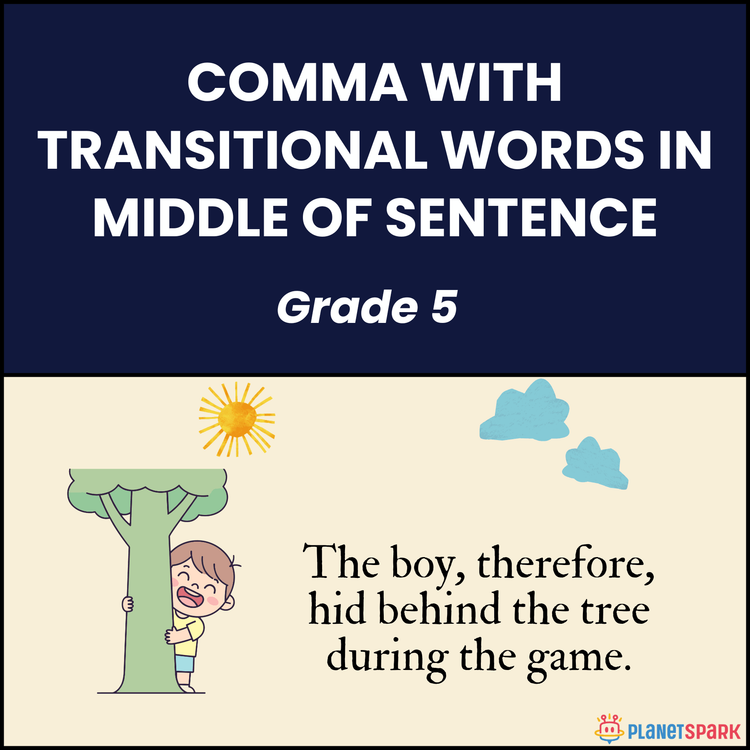
Class 5 Worksheet on Commas with Transitional Words
Comma with Transitional Words in Middle of Sentence for Grade 5
This Grade 5 worksheet focuses on building strong grammar skills by teaching students how to properly use commas with transitional words in the middle of sentences. Transitional words like "therefore," "however," "for example," and "consequently" are essential for connecting ideas and improving writing flow. Students will complete activities such as choosing the correct sentence, filling in blanks, and rewriting sentences.
These exercises encourage understanding of punctuation rules in context, ensuring practical, age-appropriate grammar learning. With this worksheet, the child will develop better sentence structure and clarity in writing by mastering the use of commas with transitional words.
Why Comma with Transitional Words in Middle of Sentence Matter in Grammar?
Commas help clarify meaning by indicating pauses between transitional words and ideas because:
1. It makes sentences easier to understand and more grammatically correct.
2. Transitional words like "however," "therefore," "for example," and "consequently" improve sentence fluency, connecting ideas smoothly and strengthening writing clarity.
3. Transitional words link ideas, making writing flow more smoothly.
4. They help the reader follow the logic of the argument or narrative.
What’s Inside This Worksheet?
This worksheet includes five grammar-rich activities designed to help learners practise commas with transitional words in middle of sentence:
Exercise 1 – Multiple Choice Questions
Students choose the correct sentence showing correctly punctuated sentences.
Exercise 2 – True or False
Students evaluate statements about punctuation rules.
Exercise 3 – Add the Commas
Students insert commas around transitional words such as consequently or therefore.
Exercise 4 – Sentence Rewriting
Students rewrite sentences by correcting punctuation in given sentences.
Exercise 5 – Paragraph Completion
Students complete a paragraph by correcting punctuation in a real-life context.
Commas help clarify meaning by indicating pauses between transitional words and ideas, making sentences easier to understand and more grammatically correct.
Answer Key (For Parents and Educators)
Exercise 1 – Choose the correct sentence
1. b) She was excited, therefore, she participated enthusiastically.
2. c) The food, on the other hand, was rather spicy.
3. c) She was, however, too tired to make the trip.
4. a) Ravi, despite the delays, completed the project on time.
5. b) Aarav will, consequently, finish his work.
6. b) My dog, for example, loves to eat peanut butter.
7. a) The weather, however, was much colder than expected.
8. a) Playing outside, for instance, is a great way to get exercise.
9. b) The vegetable pulao, moreover, was ice cold.
10. c) We will, of course, help you.
Exercise 2 – True or False
1. True
2. True
3. False
4. True
5. False
6. True
7. False
8. False
9. False
10. True
Exercise 3 – Add commas in the correct places
1. The evidence is, therefore, clear and undeniable.
2. The cat, furthermore, was very fluffy.
3. She, however, came home late.
4. We can bring chocolates, for example, to the party.
5. Anu decided, therefore, to try again.
6. The trail, in fact, was much steeper than we thought.
7. The ice cream, of course, melted in the summer sun.
8. Our car, as a result, needed a brand-new battery.
9. The store, consequently, ran out of bread before noon.
10. Some animals, for instance, hibernate during the cold winter months.
Exercise 4 – Rewrite the sentences by inserting commas
1. I love fruit, specifically green apples, the most.
2. The puppy, meanwhile, was tearing up a shoe.
3. The weather, consequently, became too cold to swim.
4. Ravi is, nonetheless, still working.
5. They, however, decided to leave early.
6. Isha, indeed, was not feeling well.
7. We, therefore, must start studying now.
8. The park is pretty and, furthermore, very quiet.
9. Some animals, for example, foxes change colour.
10. Meera decided, instead, to walk to the park.
Exercise 5 – Fill in the blanks with commas around transitional words
1. The sun, however, came out just in time.
2. We, therefore, boarded the bus with a lot of excitement.
3. We wanted to see the big cats, specifically, the African lions.
4. Some animals, for example, the penguins, were already eating their lunch.
5. We stayed to watch the show, instead, of going to the gift shop first.
6. The zookeeper explained that the animals were happy and, furthermore, very healthy.
7. The monkeys were, of course, very noisy, but we didn’t mind the racket at all.
8. We, consequently, learned a lot about nature.
9. It was, indeed, the best field trip ever!
Help your child master punctuation and transitional words with a Free 1:1 Grammar Skills Trial Class at PlanetSpark.
Frequently Asked Questions
Transitional words help connect ideas, and a comma is placed after them, such as "however" in "However, we decided to wait."
Yes, they may forget to add the comma after words like "therefore" or "meanwhile," which can make sentences harder to follow.
Have students write sentences using transitional words and encourage them to place commas in the correct spots, like after "therefore" or "consequently."